Q For Noobs Chapter 2
Drops 11-14

Welcome to Chapter 2 of Q for Dummies! Today we will be going over Drops 11-14, with a pretty big unpacking of Drop 14.
Thank you all so much for the support and love for the return of Q For Noobs! Reminder: Episode 2 will air tonight at 7pm EDT here: Q For Noobs Episode 2 on Rumble
In this chapter, we are gonna dive headlong into the importance of the Military as well as Article II of the Constitution.
Without further delay - Let’s go ahead and dive in!
Drop #11 10/29/2017
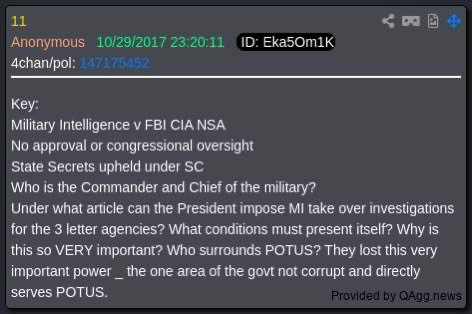
Now, I know I said in Chapter 1 that I wouldn’t be answering every question in every drop. Today is going to be an outlier, because drops 11 & 14 deserve a little digging to help set the stage for what is to come in the next few chapters.
Drop #11 is very important, and you may be asking why. Because at first glance it seems pretty vague.
In the last chapter, we went over the advantages of using Military Intelligence as opposed to the alphabet agencies. And Q picks up where he left off here in this drop.
Q tells us immediately that MI (Military Intelligence) does not require Congressional oversight, or approval. And that is important as it keeps prying eyes away from information vital to National Security, thus, keeping bad actors from knowing the intimate details of any ongoing operations or investigations.
“State secrets upheld under SC”. Here Q is telling us that there are Supreme Court rulings which uphold state secrets and their need for secrecy.
What, exactly, is Q referring to? Well, let’s have a look, as it is going to become very important before we are done with this drop.
The U.S. Supreme Court upholds state secrets primarily through the common-law “state secrets privilege,” an evidentiary doctrine that allows the executive branch to protect sensitive national security or military information from disclosure in civil litigation when it could harm national security.
This privilege is not explicitly in the Constitution but derives from the executive’s Article II powers over national security, foreign affairs, and military matters. Courts balance judicial oversight with deference to the executive, though critics argue it can shield misconduct.
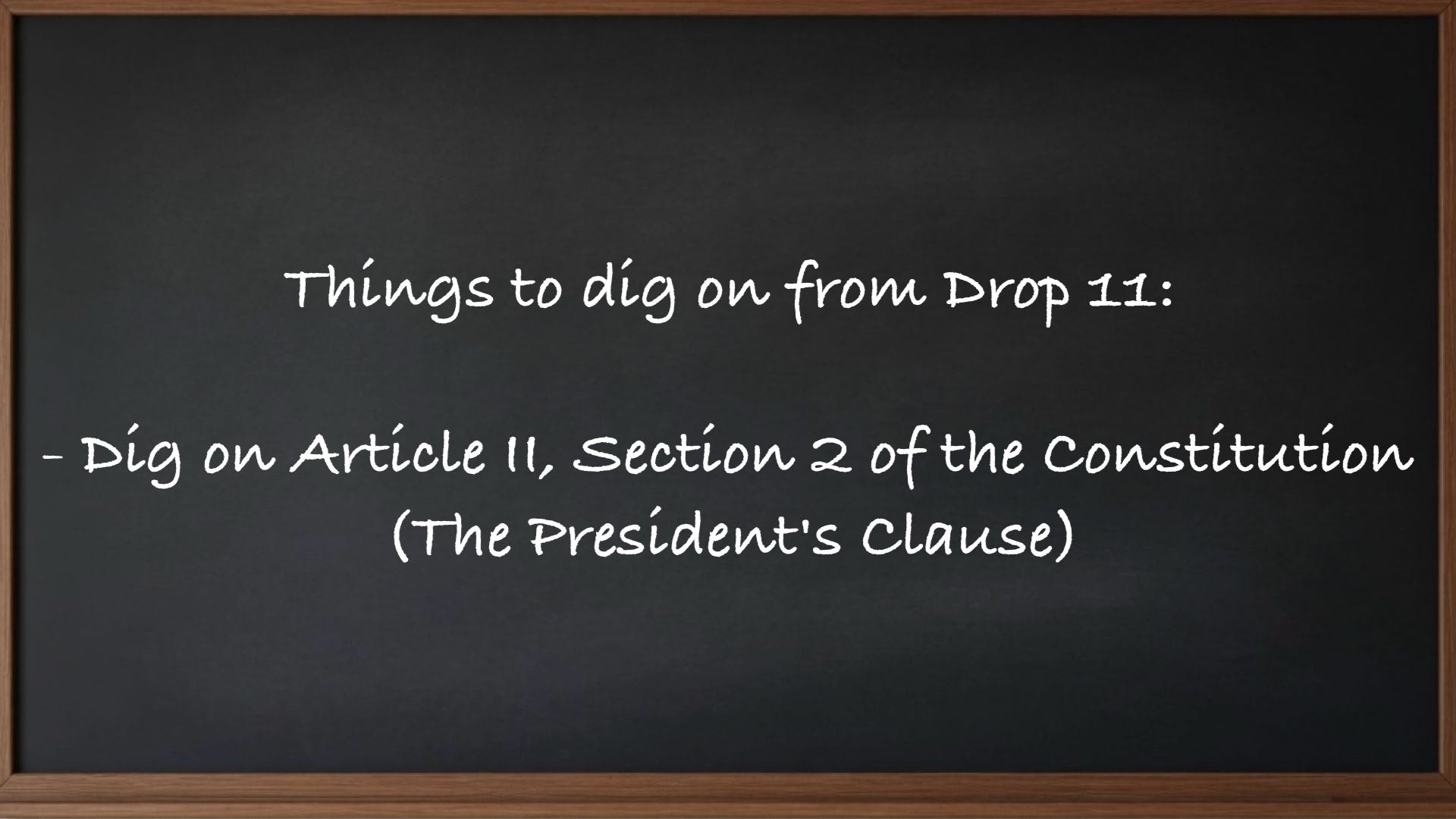
Did you catch it? This privilege is not in the Constitution, HOWEVER - it is derived from the powers granted to the Presidency through Article II, Section 2 of the Constitution. What is Article II, Section 2? Don’t worry - we will get there very shortly.
Key Supreme Court Precedents:
• Totten v. United States (1876): The Court established an early form of protection (often called the Totten bar). It dismissed a contract claim by the estate of a Civil War spy because litigating it would inevitably reveal confidential espionage matters. The principle: Courts lack jurisdiction over suits where the “very subject matter” is a state secret, as public policy forbids trials that would disclose matters the law regards as confidential. This acts as a categorical bar in rare cases involving secret agreements or operations.
• United States v. Reynolds (1953): This is the foundational modern case for the evidentiary privilege. Widows of civilians killed in a B-29 bomber crash sought accident reports, but the government claimed they contained military secrets. The Court held that the privilege:
• Belongs to the government and must be formally asserted by the head of the relevant department (e.g., via affidavit) after personal consideration.
• Is “not to be lightly invoked.”
• Requires the court (not just the executive) to decide whether to uphold it, but with significant deference to the government’s assessment of harm.
• Allows exclusion of specific evidence if there is a “reasonable danger” that disclosure would expose military matters harmful to national security.
Notably, the withheld report was later declassified and contained no secrets (only embarrassing details about aircraft maintenance), leading to criticism of potential abuse. The Court did not automatically dismiss the entire case but excluded the privileged evidence.
Up next, Q asks us who is the Commander & Chief of the Military. This is pretty obvious: The President of the United States is the Commander & Chief of the military. Period.
And that becomes vastly important when we dive into the bottom of this drop, because Q asks us “Under what article can the President impose Mi take over investigations for the 3 letter agencies?”. Q isn’t talking about a headline news article, Q is talking about Article II, Section 2 of the United States Constitution. What is Article II, Section 2? Well, it is, in effect, the most powerful tool available to the President in the entire Constitution.
Let’s break it down.
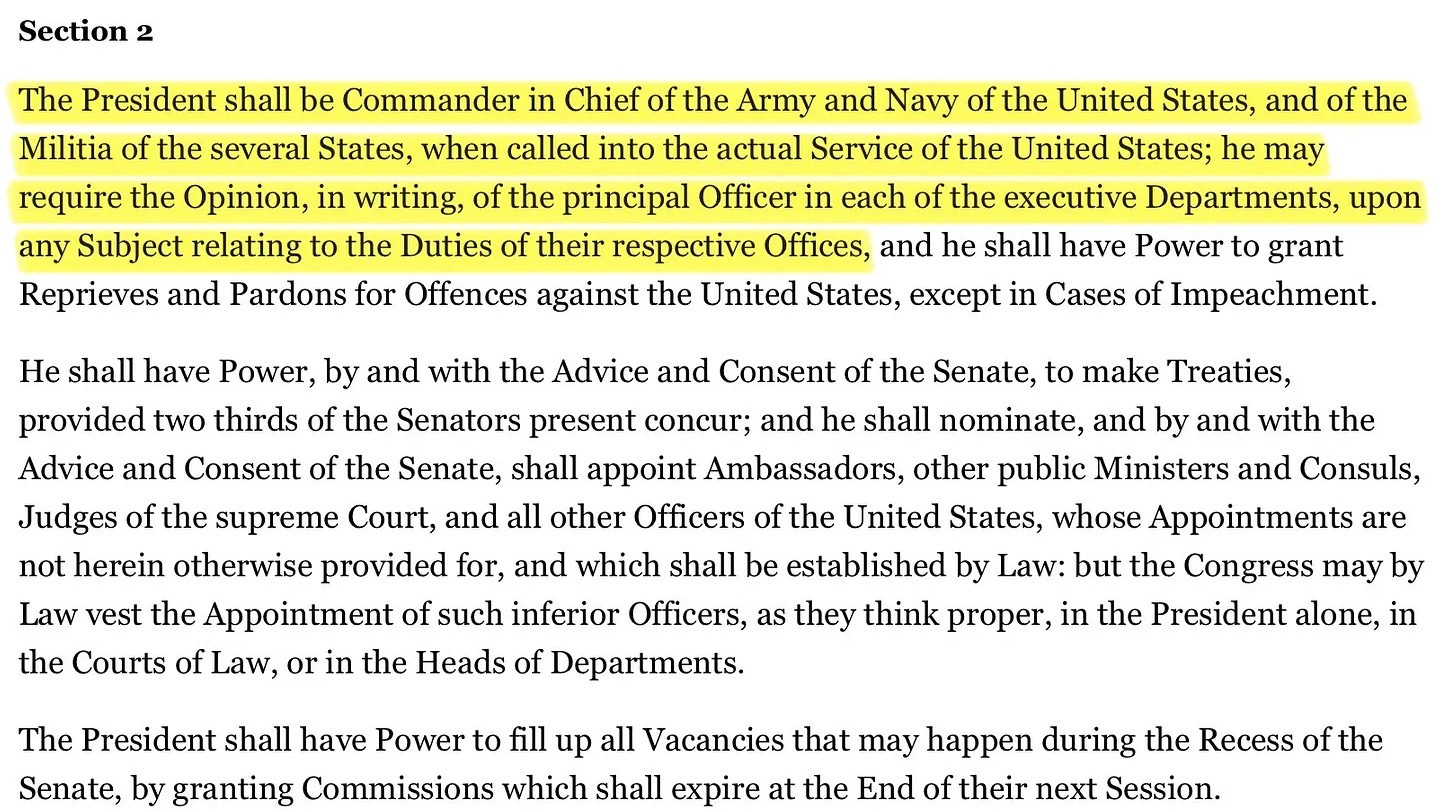
This is Section 2 of Article II of the Constitution.
The highlighted section is known as the “Commander In Chief” Clause. And basically, as long as their actions are legal and Constitutional, they can, in fact, wield a whole lot of power as it pertains to the military. Especially if the Nation was under a National Emergency. Such as we saw during Covid, and like we have now with the National Emergency declared at the Southern Border, or the potential National Emergency which may be declared over elections.
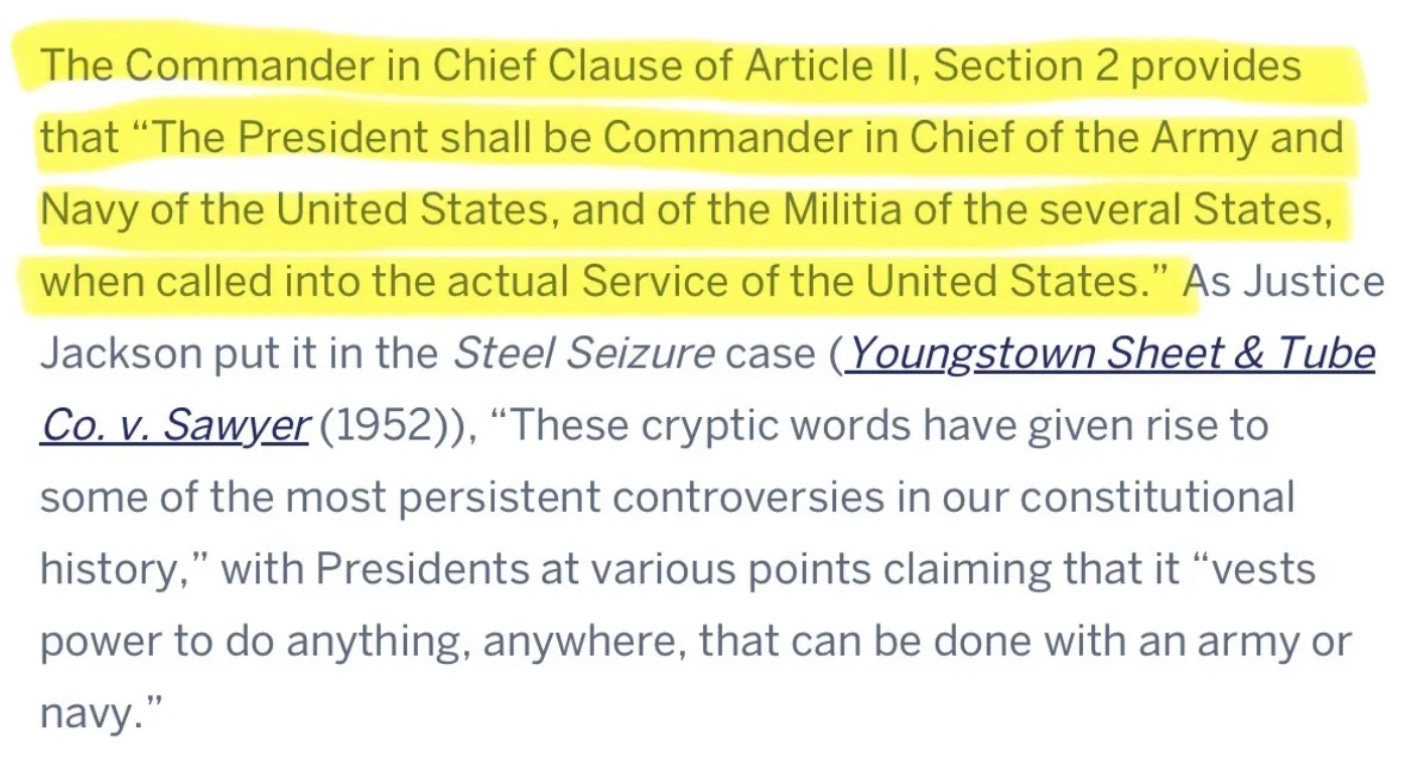
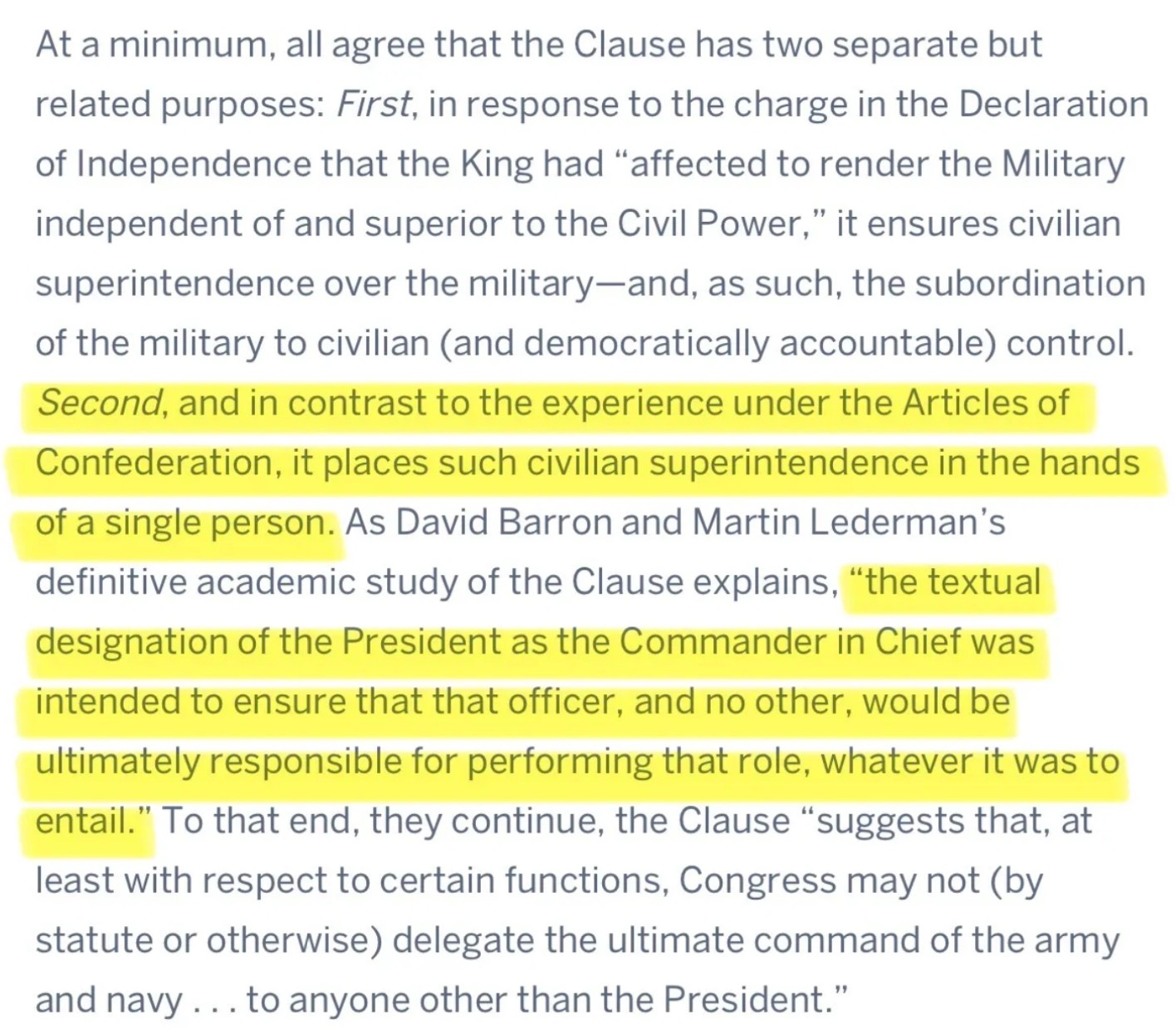
It is pretty clear that if the President invokes Section 2 of Article II, that he controls the military. And he can invoke that article if he has reason to believe that the country is under imminent threat.
So, when Q asks us what conditions must be met - that is what Q is referencing. The fact that extraordinary situations must be met in order to invoke the Presidential Clause. Not sure about y’all, but I am pretty sure Communist Infiltration into every single facet of your government and country meets the required conditions in order to invoke the Presidential Clause.
And let us not forget, President Trump has done his fair share of seeding Article II - have a look:
Pretty clear he knows all about Article II, Section 2, no?
Q then infers that the deep state does not control our military, and that fact would be their undoing. Q will expand upon “who surrounds POTUS” in Drop #14.
Drop #12 10/30/2017
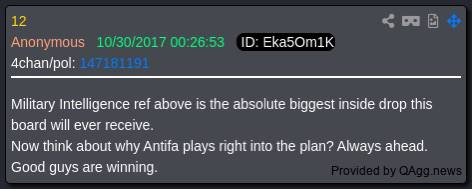
Short and sweet, this drop is.
Q tells us that the military intelligence reference in the prior drop is the biggest inside drop the boards will ever receive. Not Drop 22, or 55, or 521 (the importance of those drops will become clear as we get further along). No, Q is telling us that the MI reference made in Drop #11 is the biggest inside drop this board will EVER receive.
What does Q mean? Well, I clearly don’t have the answer as I am not on Q-Team. However, I feel comfortable in positing that I believe Q is telling us that Article II, Section 2 HAD ALREADY BEEN INVOKED.
Think about that for a second, and what that means. It could very well mean that everything we have witnessed with President Trump has, in fact, been a military operation from the word go. And if you think it began when he came down the escalator, just wait until we get further along in our journey here.
Antifa plays into the plan because they are the literal walking proof that the deep state has been slowly placing their foot soldiers in place in this country for a long time. There is far more to come on Antifa later in the drops.
I will say this, though - The military operation to subvert the communists trying to tear down our country probably dates back AT LEAST this far:
Drop #13 10/30/2017
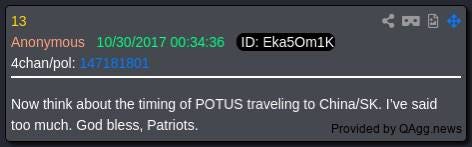
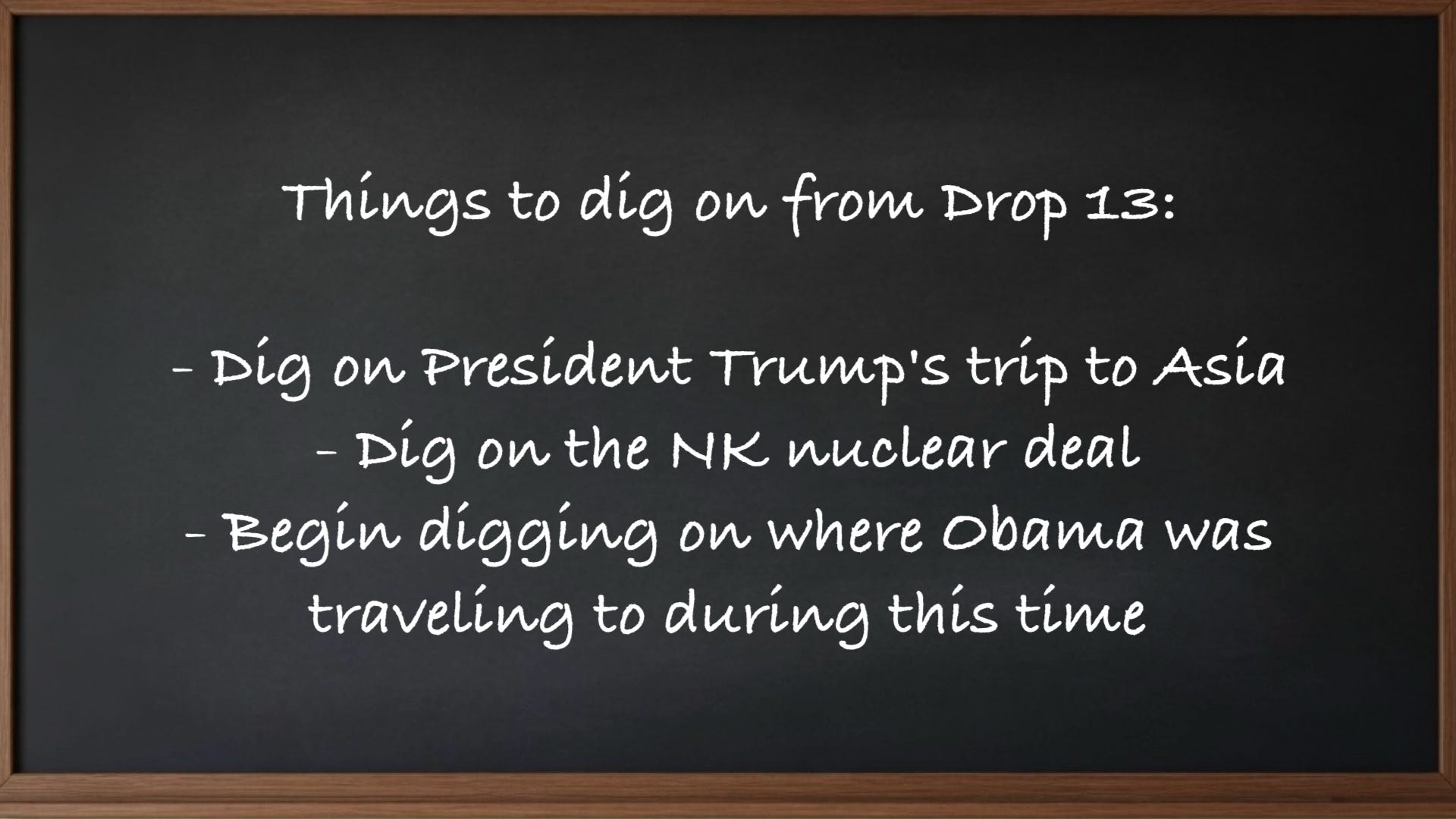
After having just dropped the crumbs that were dropped, Q then asks us to consider the timing of President Trump’s trip to Asia in the fall of 2017. It seems to me that Q was inferring that this trip had far more of a military context than diplomatic.
What do I mean? Well, let’s take a look at that trip and ask Grok some questions about what happened:
President Donald Trump’s visit to South Korea and China in November 2017 was part of his longer 12-day Asia tour (November 3–14), which also included stops in Japan, Vietnam, and the Philippines. It focused heavily on North Korea’s nuclear and missile programs, trade imbalances, and strengthening alliances.
South Korea (November 7–8, 2017)
This was Trump’s first visit to South Korea as president and the first U.S. presidential state visit there in 25 years. He arrived at Osan Air Base and met with President Moon Jae-in.
Key events and highlights:
• Bilateral meetings and state dinner at the Blue House (Cheong Wa Dae).
• Address to the National Assembly in Seoul: Trump delivered a strong speech contrasting the prosperity of South Korea with the oppression in North Korea. He praised South Korea’s success, emphasized the U.S.-ROK alliance, warned North Korea against aggression (“Do not underestimate us”), and offered a “brighter path” if it chose denuclearization. He stressed “maximum pressure” on Pyongyang while keeping the door open to diplomacy.
• Visited U.S. and South Korean troops (including at Camp Humphreys) and met with American and South Korean military personnel.
• Trade and economic outcomes: South Korean companies announced intentions for major investments in the U.S. (around $17.3 billion in projects) and purchases of U.S. goods/services (about $57.5 billion, including energy).
The visit reinforced the U.S.-South Korea alliance amid heightened tensions with North Korea, following multiple missile tests earlier in 2017. Trump and Moon coordinated on a firm stance toward Pyongyang.
China (November 8–10, 2017)
Trump traveled directly from South Korea to Beijing for his first state visit to China, hosted by President Xi Jinping. The trip featured elaborate pageantry, including a welcome ceremony at the Great Hall of the People.
Key events and highlights:
• Bilateral meetings with Xi and Premier Li Keqiang on U.S.-China relations, North Korea, trade, and regional issues.
• Trump praised Xi personally and highlighted “great chemistry” between them. Discussions covered applying pressure on North Korea (China was seen as key due to its economic leverage) and addressing the U.S. trade deficit with China.
• Cultural elements: Trump and Xi visited the Forbidden City (or related sites like the Temple of Heaven in some accounts).
• Economic outcomes: Announcements of significant commercial deals worth hundreds of billions of dollars (estimates around $250 billion in potential value), including in energy, aviation (e.g., Boeing), agriculture, and manufacturing. These were framed as wins for U.S. exports and jobs, though many were memoranda of understanding (MOUs) rather than immediate binding contracts.
The visit was notably warm in tone compared to Trump’s earlier campaign criticisms of China. North Korea remained a priority, with Trump seeking Beijing’s cooperation on sanctions and diplomacy.
Overall Context of the Asia Trip
• The tour emphasized “peace through strength,” free and fair trade, and countering North Korea’s provocations.
• No major breakthroughs on denuclearization occurred immediately, but it set the stage for later diplomacy (e.g., the 2018 Singapore Summit with Kim Jong-un).
• The visits were generally viewed as successful in strengthening personal ties with Xi and Moon while showcasing U.S. resolve.
These events are well-documented in White House archives, contemporary news reports, and official transcripts. The trip occurred during a period of high tension on the Korean Peninsula, with Trump balancing tough rhetoric toward North Korea and pragmatic engagement with China.
What I want to focus on is the signal from this trip (we will dive in on President Trump’s most recent visit to China in a future chapter).
What is the signal here? Well, look at the way he was received. And then remind yourself that in June of 2018 (almost 8 months after this post was made) the North Korea deal was announced with President Trump traveling to North Korea to meet with Kim Jong.
Q is telling us right here, in Drop #13, that the purpose for President Trump’s first visit to Asia was to get the North Korea deal done. And that is why he received the welcome that he did in Vietnam, South Korea and China - because he had just disarmed a very real and very unilateral nuclear threat in their region. And that threat of course, was the puppet state of North Korea.
Drop #14 10/31/2017
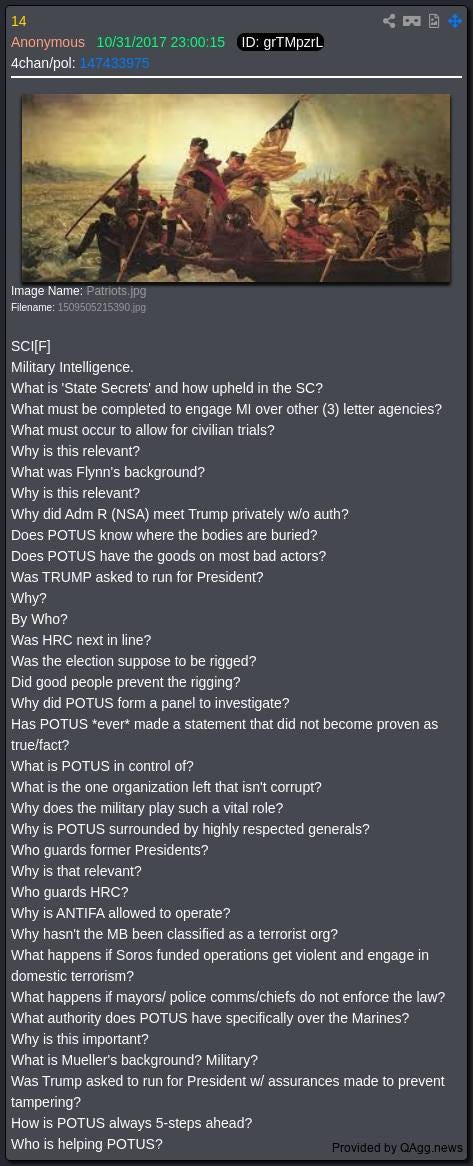
I am going to break this drop down in a few different segments, so let’s start of at the very top.
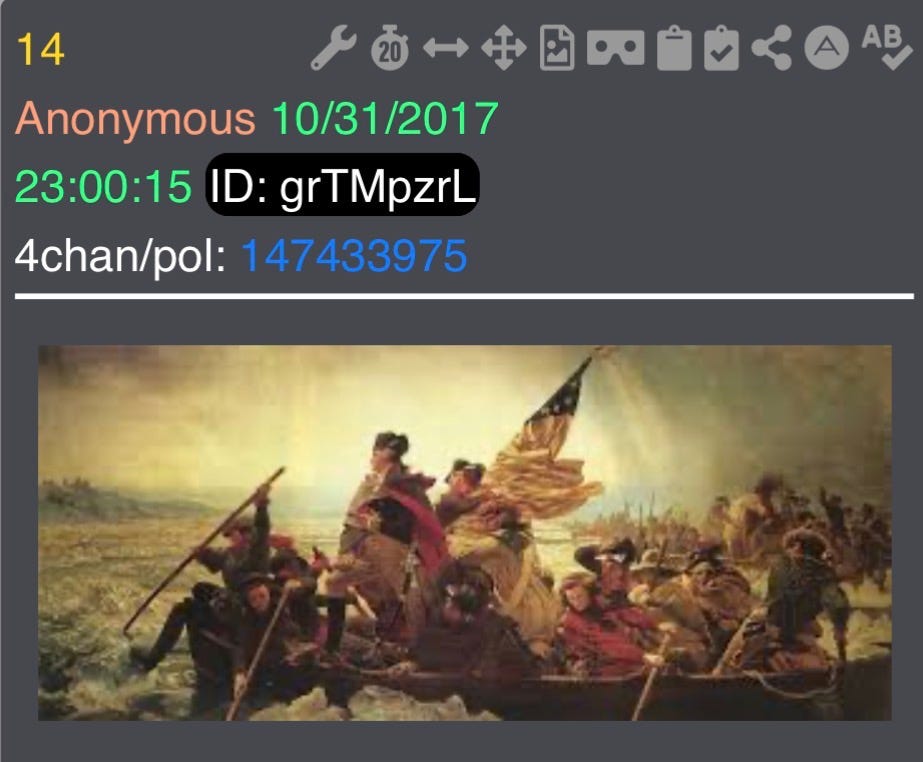
The drop leads off with the famous image of George Washington crossing the Delaware River during the Revolutionary War. This was a seminal moment in the war, and the argument can be made that without Washington and his troops crossing the Delaware, we don’t win the war. So, I hope the symbolism of using this photo here isn’t lost on anyone.
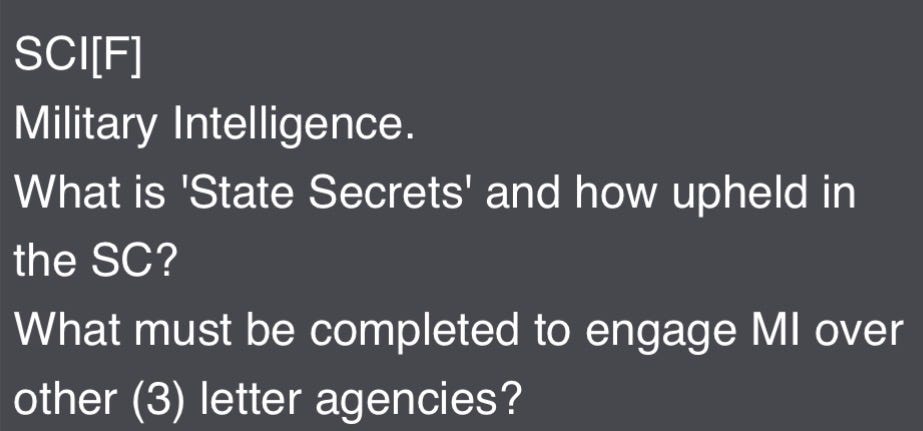
What is a SCIF?
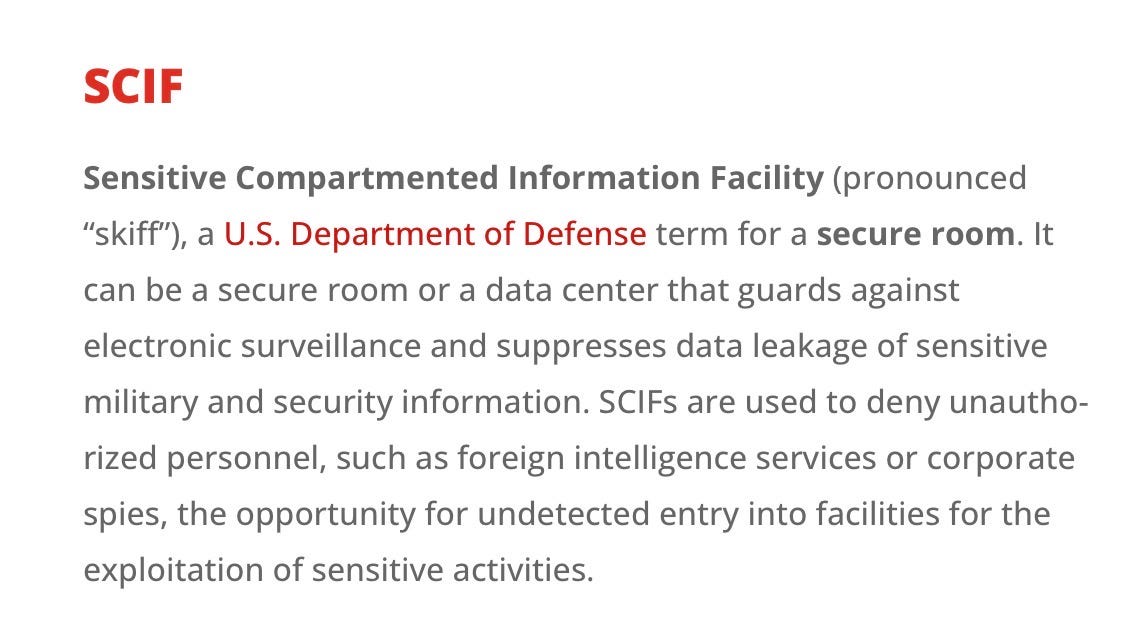
A SCIF is a room in which you are shut off from everything. No communication in, no communication out unless through the most secured means. A SCIF cannot be eavesdropped on or surveilled.
Q then reiterates what was said in Drop 11 about State Secrets and the Supreme Court. This is important information to remember as the drops unfold, hence why Q keeps repeating it.
To answer “What must be completed to engage MI over (3) letter agencies” - You must show that they are compromised. Essentially in these drops, Q has told us that Section II has been invoked, and that Military Intelligence has been engaged over those agencies because they were not working in the best interest of the American people.
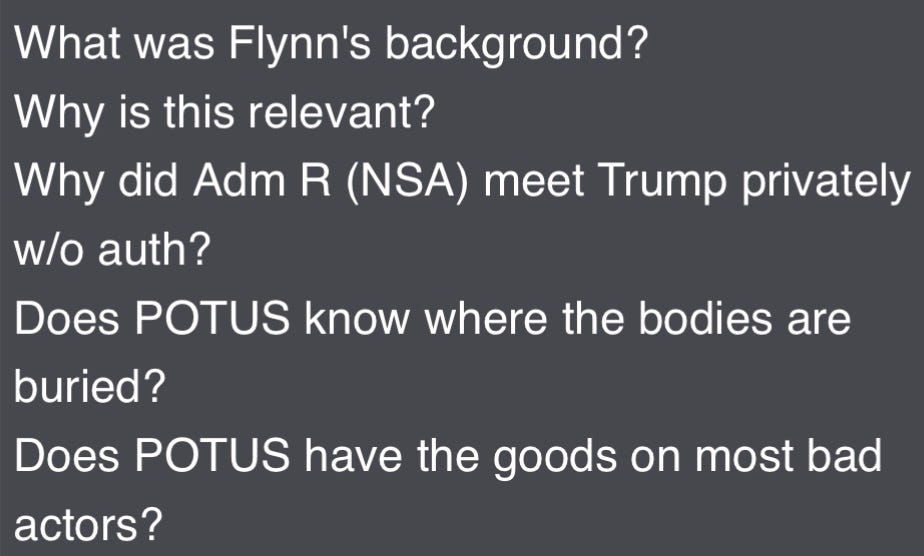
General Flynn was involved with Military Intelligence and Psychological Operations for the entirety of his career. He will come up quite often through the drops, but this part is important to remember, because - yes, POTUS knows where the bodies are buried, and he has the goods on most bad actors. How did he obtain that information? From soldiers like General Flynn and Admiral Rogers who had spent their entire careers documenting how the deep state was moving against us.
Speaking of Admiral Rogers:
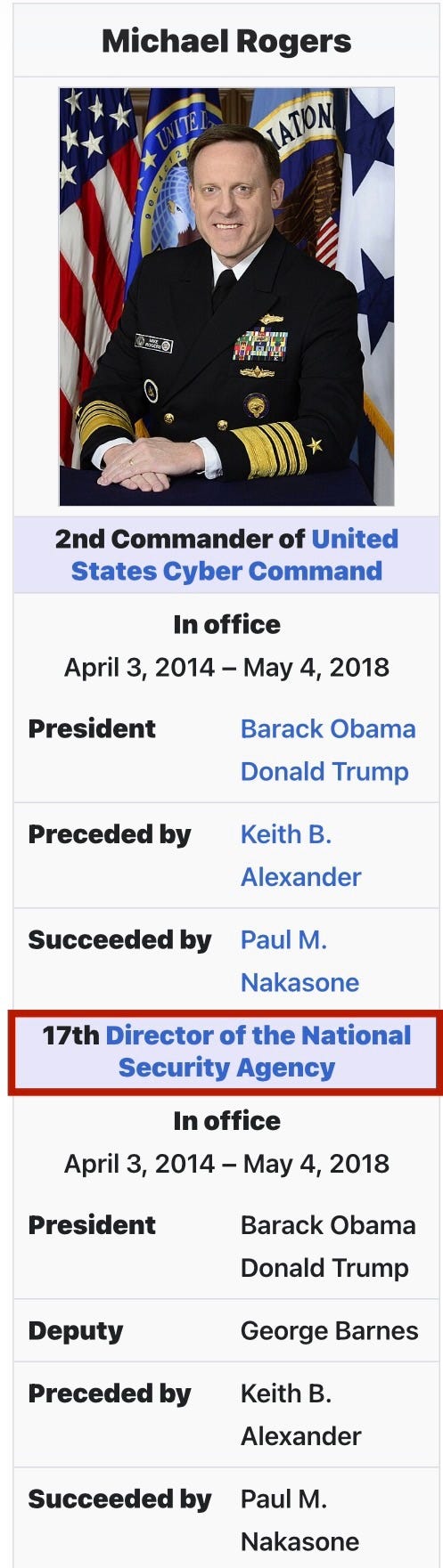
He was the 17th Director of the NSA. Because why not?
Q brings up Admiral Rogers meeting with President Trump at Trump Tower in 2017, before he was inaugurated.
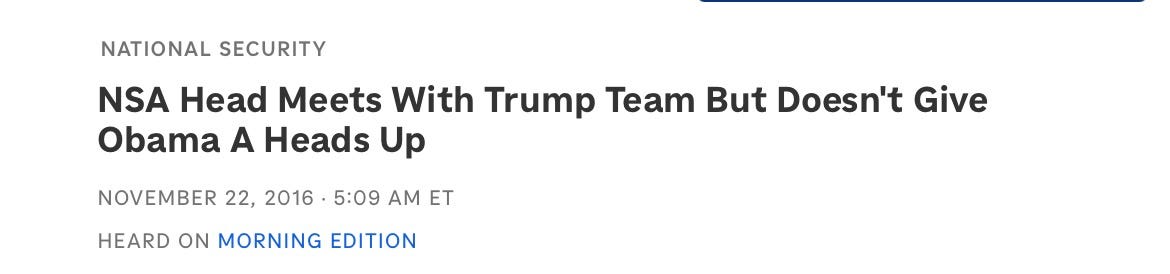
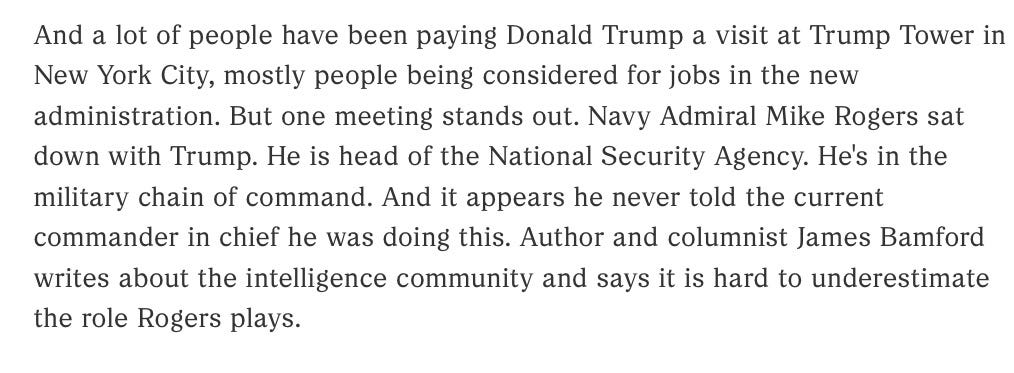
Ask yourself this: Why would Admiral Rogers meet with the incoming President but not tell the sitting President about this meeting? It’s pretty simple: Because the meeting had nothing at all to do with Admiral Rogers giving President Trump a heads up about “Russian spying” and everything to do with Admiral Rogers giving President Trump a heads up that he was being spied on by the Obama Administration.
Have a look here at this video featuring Admiral Rogers & General Flynn:
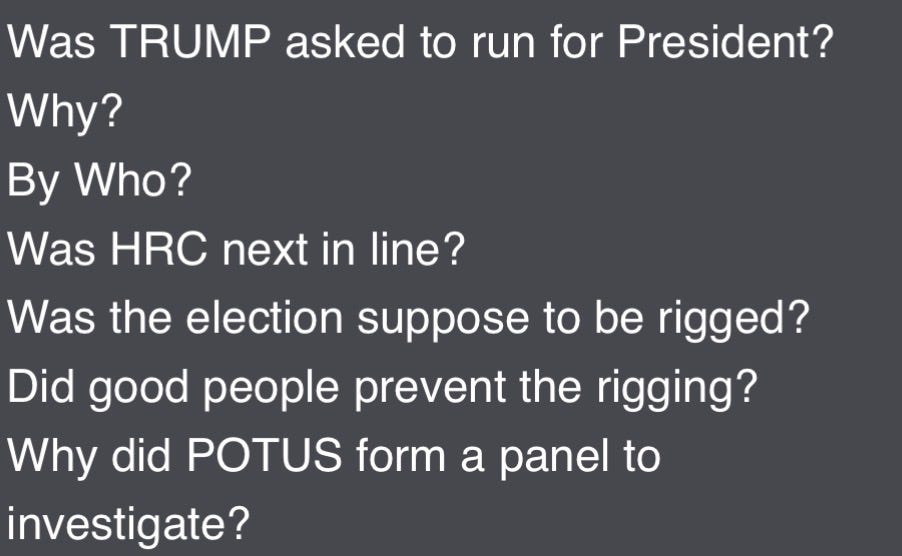
I want you to look at this section of the drop through the lens that Q is asking rhetorical questions here.
“Was TRUMP asked to run for President” - Yes, he was.
“Why?” - Because he is incorruptible.
“By Who?” - Why do you think Q has made such strong mentions of the military this early in the drops? IMO, it was the military that asked President Trump to run.
“Was HRC next in line?” - I don’t know … you tell me:
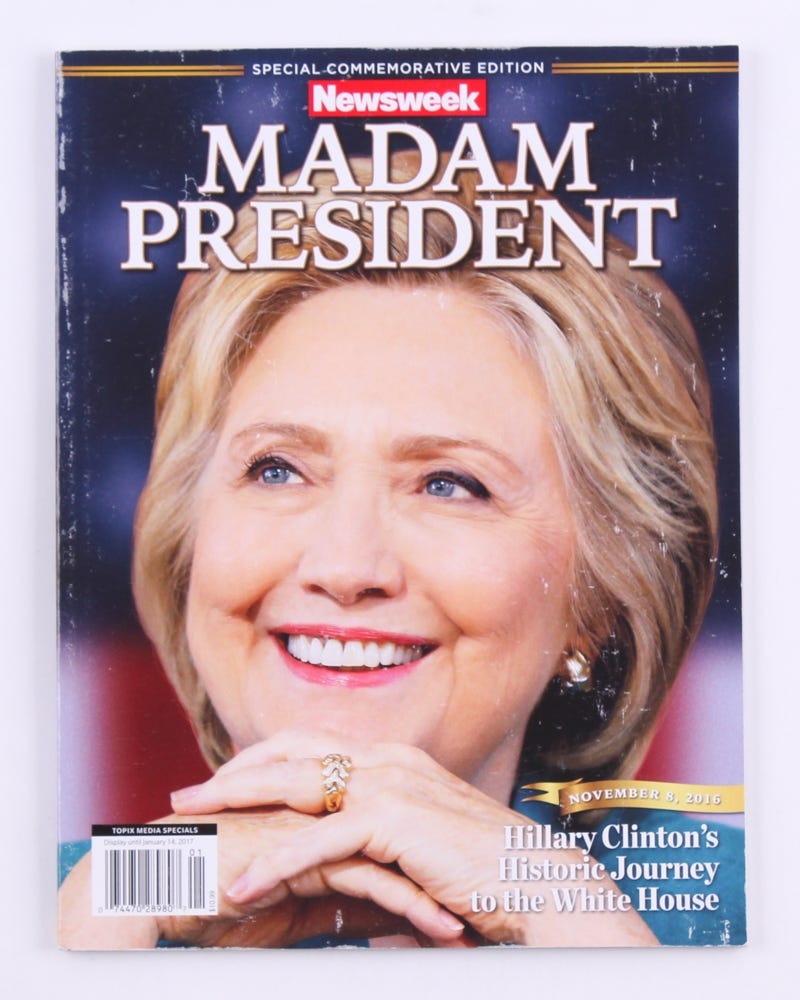
“Was the election supposed to be rigged?” - Yes, it was. And it is my belief that the left pivoted against Russia because Russia more than likely help with unrigging the election.
Hillary was supposed to have been the last nail in the coffin. The finisher for the 16 year plan to destroy America. The military was not going to let that happen.
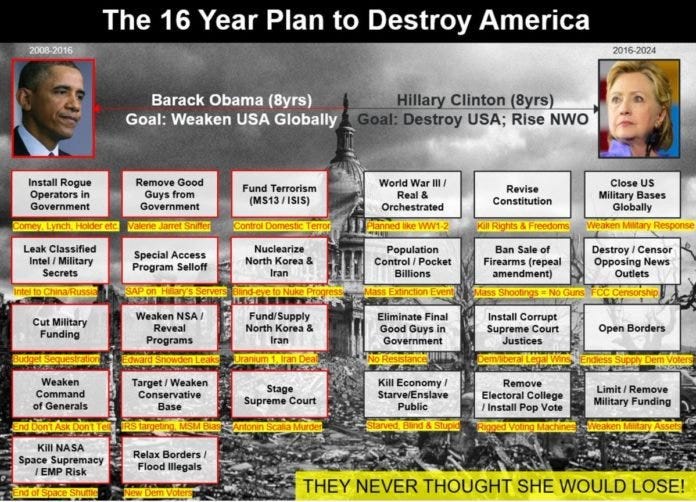
They truly never thought she would lose.
Q then asks why POTUS formed a committee to investigate, which tells me that POTUS has been hot on the trail of stolen elections from day one, and when you take a look at what is happening with the SAVE Act, it is becoming easier to see where this road will lead (exposure and accountability).
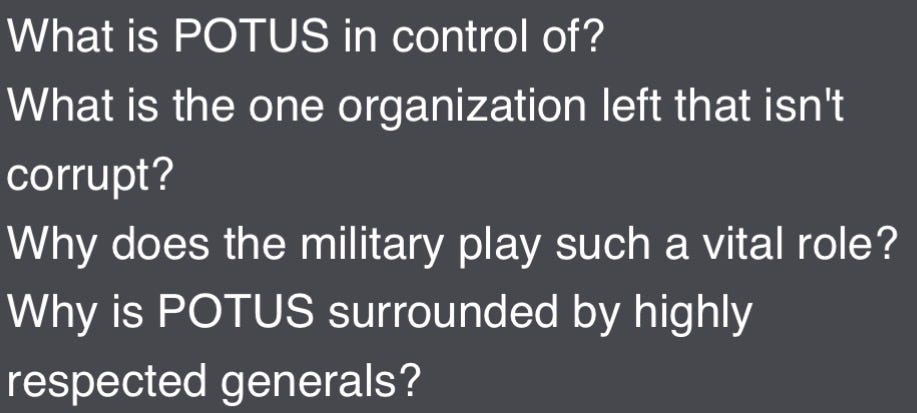
POTUS controls the military. Q has made that very clear. Especially as it relates to Article II, Section 2 of the Constitution.
The military is the one organization left that isn’t corrupt.
The military plays such a vital role because not only do they have all the information on the enemies of this country, but they also possess means to address it that no other entity in the country can match.
POTUS is surrounded by highly respected generals because this is a military operation, as I previously mentioned.
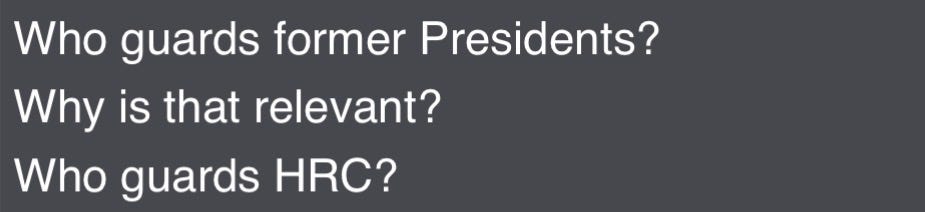
The United States Secret Service guards all former Presidents and their families. Which means they still guard HRC. Why is that relevant? Simple: Because agents are privy to conversations no one else is, and remember - they swear an oath to the Constitution, not any one person. Do you really believe every Secret Service agent who was around Hillary, or Bill, or Obama etc, and heard something treasonous has kept quiet about it? I seriously doubt it.
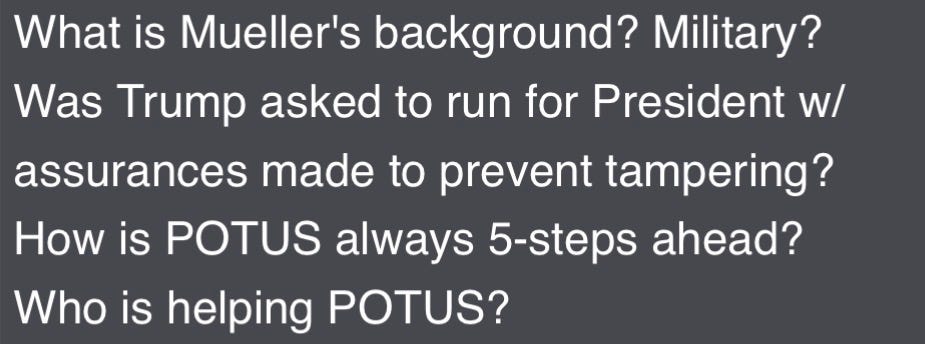
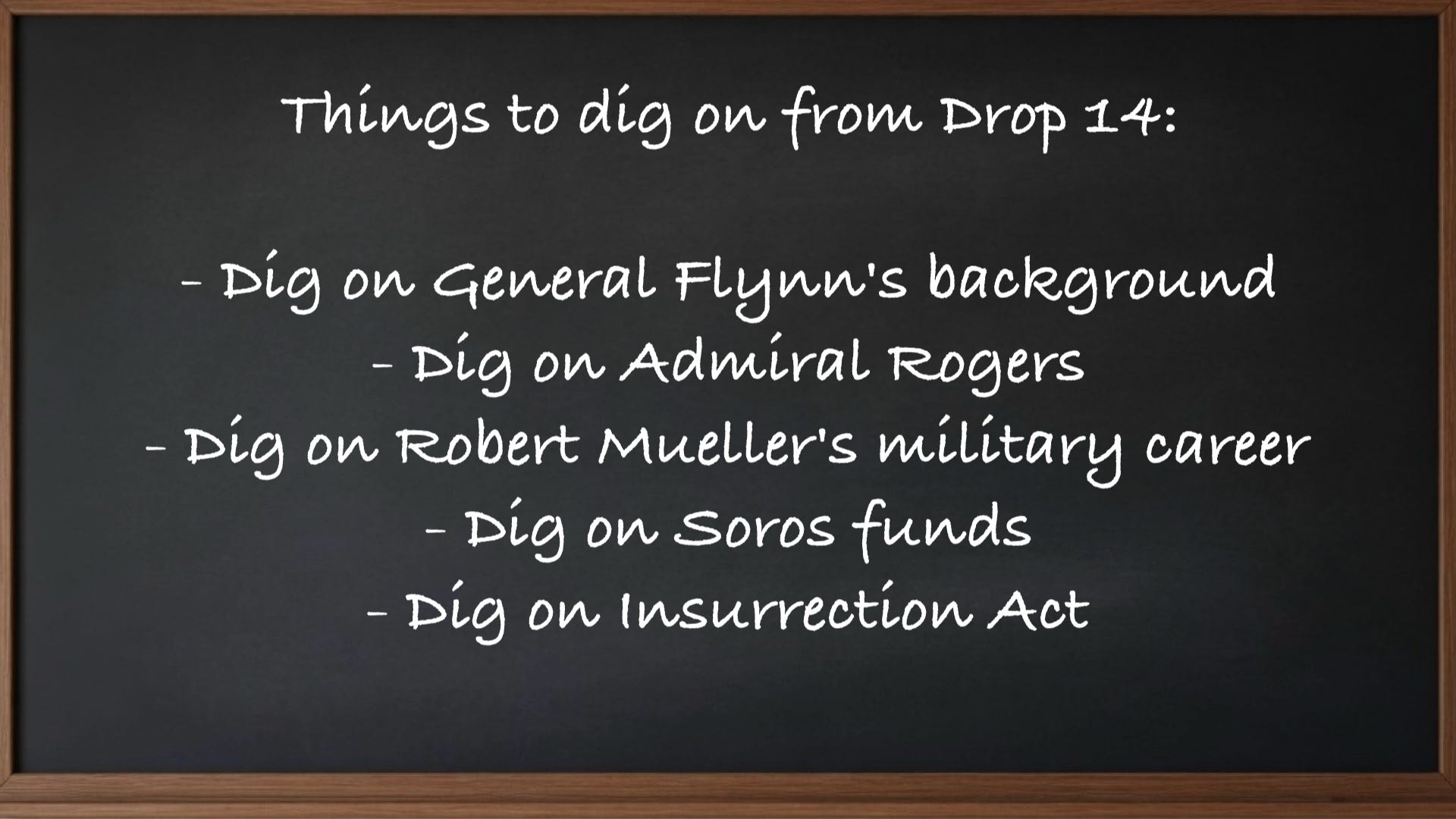
I will end this drop with this section. The questions from this drop I haven’t addressed will be addressed in future chapters, and of course, I wanted to leave some stuff for you folks to dig on and research.
Robert Mueller was a Marine, and a highly decorated one at that. Take from that what you will, but Q is already showing you that Mueller may not be who we all think he is.
I believe the next question is again, rhetorical. I do believe POTUS was given assurances that the 2016 Election would be free and clear of rigging, and as such, he chose to answer the call and run.
POTUS is always five steps ahead because he is being helped by the military and military intelligence.
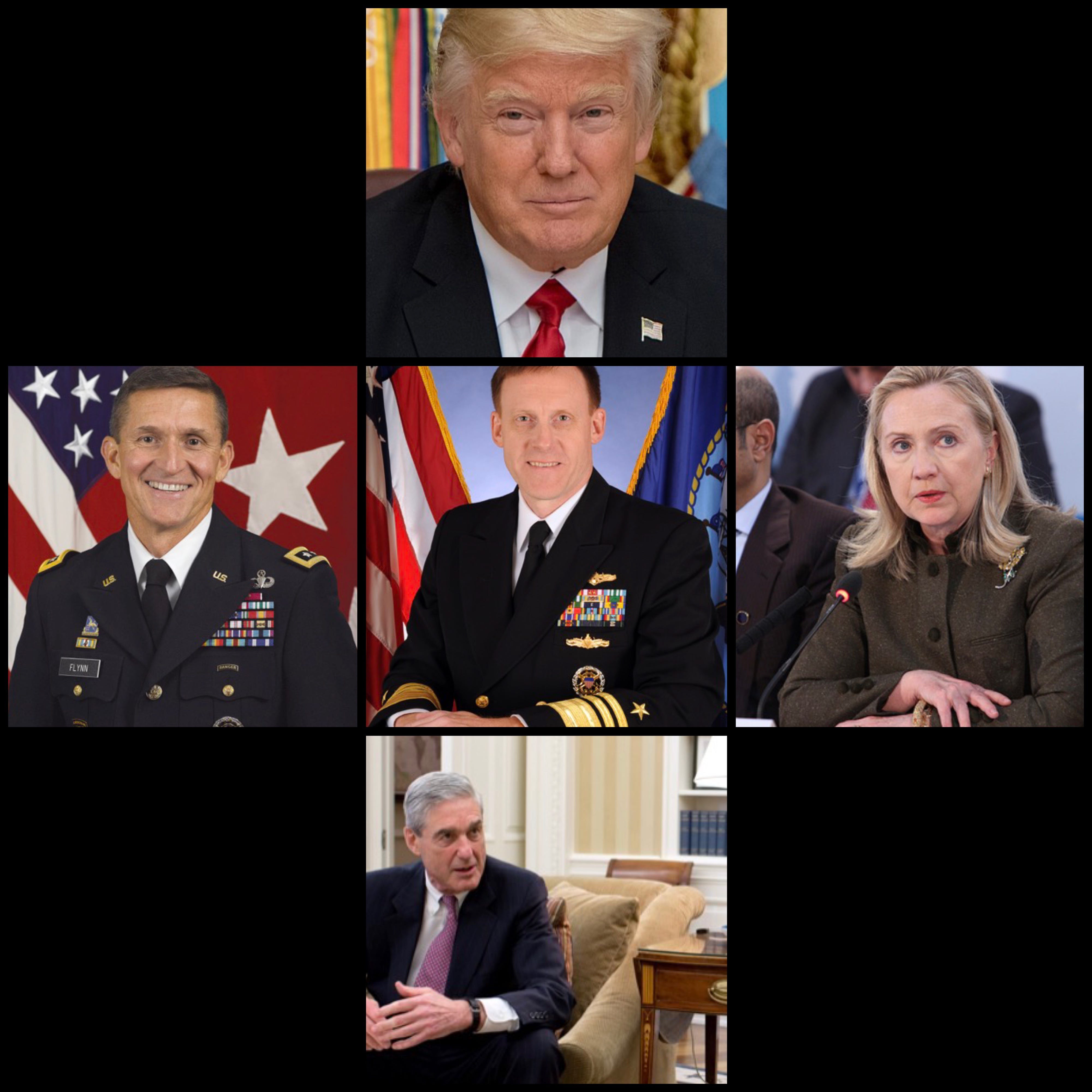
Players in Drop #14: Admiral Rogers, President Trump, General Flynn, HRC, Robert Mueller
And that will wrap us up for Chapter 2 of Q For Noobs! I hope you frens have enjoyed and been able to learn something!
Make note: There will be no new chapter next week as Barb and I will be taking some time to celebrate our anniversary! I look forward to returning the following week (July 20th) with a brand new chapter for you fine frogs!
Until then, thank you so much for the love and support! All glory goes to the Father. WWG1WGA